




What do I need to take into consideration when placing the greenhouse?
Ideally, the terrain should be flat. The greenhouse or tunnel should not be installed on a slope for two reasons: the strength of the structure and the uniformity of irrigation. It is not recommended to install the structure on a slope greater than 4mm / m, because a greater slope will decrease the strength of the structure. Also, the slope favors an uneven irrigation, a phenomenon that can have repercussions on the growth of plants in your greenhouse or tunnel.
It is important to also take into consideration the proximity to power and water sources and the access and drainage for wastewater (from the irrigation systems used). For winter production it is recommended to have sun at least 6 hours a day. Make sure that no obstacles obstruct the access of light, such as trees or high buildings.
Does the orientation of the greenhouse / tunnel regarding the cardinal points matter?
The best placement is on the North-South axis, but this aspect is relevant only for large industrial greenhouses (> 1 Ha) where the difference materializes in hundreds of kilograms of harvest.
Do I need a building permit?
Depending on the nature of the product (greenhouse / tunnel) and the area covered, local authorities in Romania may or may not request a building permit. Our greenhouses and tunnels are considered light and removable structures, with a foundation on concrete pads for each pillar / arch of the greenhouse / tunnel.
Check with the local authorities of where the land is registered what documents or permits you need. Sere Transilvania can provide the construction plans and all the necessary technical drawings for the products sold.
What is the difference between a greenhouse and a tunnel?
A tunnel is a horticultural structure covered with poly and unheated, in most cases. Usually, the tunnel consists of a single module with widths varying between 5 and 10m and lengths that can reach even 100m. Due to the round tunnel shape, this structure does not present a particular risk of collapse due to snow. Tunnels are also called cold greenhouses.
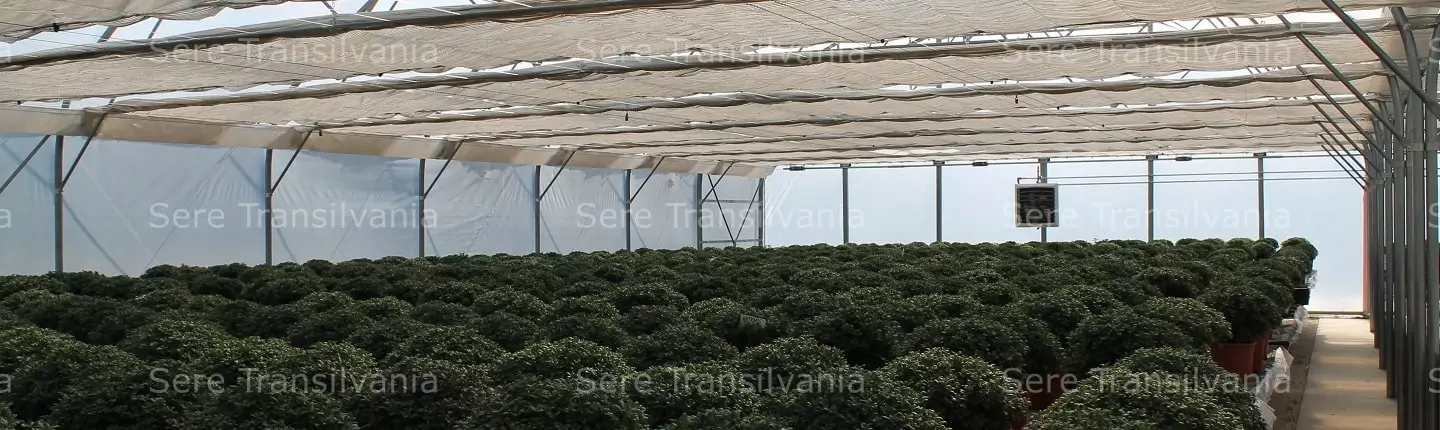
A greenhouse is a structure covered with glass or poly made up of several modules. Greenhouses, for the most part, benefit from a heating system, being intended for industrial scale production. Being modular structures it is recommended to be heated during the winter due to the risk of overload and collapse caused by snow.
What is the gutter height that I should choose?
The gutter height is determined by the type of plants you grow and the cultivation method: in soil or hydroponic. If you are considering tall plants, such as cucumbers or tomatoes, which can have indeterminate growth, it is good to choose a tall greenhouse with a gutter height of 3.5-5m. For shorter plants, such as lettuce, radishes or parsley, we recommend heights of 2.35 m. If you do not known for sure and you want to mix different types of crops, we recommend a gutter height of 2.95 m.
Before ordering a greenhouse it is good to consult with a technologist specialized in the culture you want to grow. In the case of hydroponic crops, we recommend high modular greenhouses with a gutter height of 3.5-5m.
Which natural ventilation solution should I choose for the greenhouse or tunnel?
Greenhouses or tunnels can have side or top openings. These are chosen according to the width and length of the structure and can be chosen separately or both at the same time.
For a 30m long tunnel, ventilation on the ends (double swing doors) may be a sufficient solution. For longer lengths the side roll opening is recommended. For greenhouses with several modules, the top opening is required for an efficient ventilation in the hot season. Sometimes it is recommended to combine it with side roll opening, especially in the case of tomatoes.
Glass or poly glazing?
Glass has the advantage that it has a good transparency of light over time. It only needs to be cleaned to benefit from this advantage. Unfortunately, glass is heavy, thus the structure of a glass greenhouse is much more robust and therefore more expensive than the structure of a poly greenhouse.
The poly, in addition to a transparency equal to that of glass, has the advantage that it does not break in a hail because it is elastic (> 500%). In addition, it is more resistant to snow loads. The disadvantage of the poly is that it must be changed every 5-6 years due to the gradual opacification due to dust deposition and micro-scratches.
The advantages of the glass-covered greenhouse are starting to diminish compared to poly-covered greenhouses, especially due to the qualities of the poly for agriculture. In recent years, the poly has reached a light transmission equal to that of glass. The double layer of poly with the air cushion between clearly tilts the balance in favor of greenhouses with poly glazing, due to the thermal insulation of up to 4-7 degrees Celsius offered in addition to glass. Also, the cost per square meter of poly is several times lower than that of glass.
What are the advantages of double inflated poly?
The thermal advantage - the double inflated poly allows temperature gains in the cold period as well as in the warm period, thus diminishing the effect of thermal stress on the crops. In the cold period the double poly can add about +4 - +7 degrees Celsius as opposed to a greenhouse covered with only one poly film.
The advantage of light - the double poly glazing promotes light diffusion and has a high transmission coefficient, 91%.
The mechanical advantage - the double poly having an air cushion between the films diminishes the effect of mechanical wear due to the wind and improves the longevity of the poly.
Basically, these advantages translate into significant savings for those who heat greenhouses or tunnels (thousands of euros per hectare in a single cold season). For those who do not heat the greenhouses but want to have an early start in the cultivation of plants, the double foil simply allows the extension of the cultivation period, which results in a richer harvest per season.
Is the installation included in the price?
The installation of the greenhouse or tunnel is not included in the price. Sere Transilvania is an industrial factory and deals with the production of greenhouses and tunnels. Installation can be provided by partner companies upon request.
The installation of the tunnels is quite simple (telescopic connections and fastenings with screws, without welding) and most customers choose to install their tunnels themselves. If desired, we can offer technical assistance or "turnkey" installation (the price varies depending on the surface and equipment of the tunnel and the travel distance for the team).
The installation of modular greenhouses is much more complex, especially if they are equipped with thermal screen systems, automated top openings, hydroponic irrigation systems etc. Technical assistance is recommended here if you do not want a professional installation team. The price of the greenhouse installation is calculated depending on the chosen technical solution, the equipment chosen for the greenhouse, its surface and the travel distance.
